


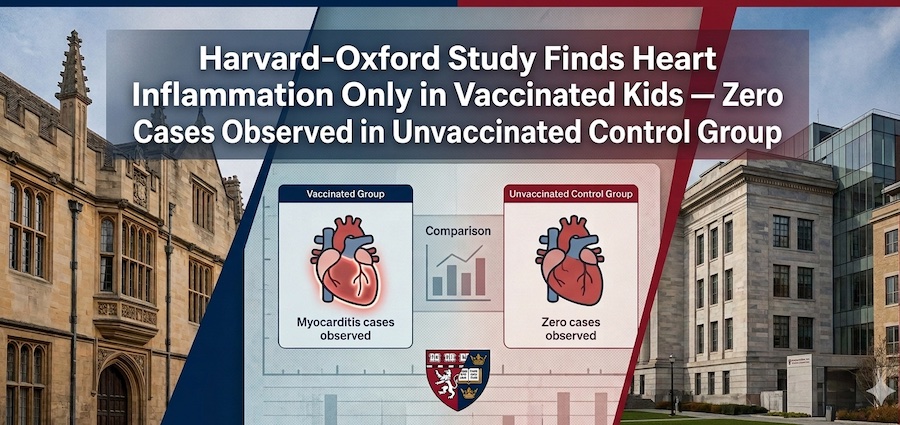
(THECOUNT) — A major peer-reviewed study conducted by researchers at the University of Oxford, the University of Bristol, and the Harvard T.H. Chan School of Public Health has found that cases of myocarditis and pericarditis — serious inflammatory heart conditions — occurred exclusively among vaccinated children and adolescents in a large-scale analysis of the Pfizer-BioNTech BNT162b2 COVID-19 vaccine, with no such cases observed in the unvaccinated control groups.
The study, published in January 2026 in the peer-reviewed scientific journal Epidemiology, examined the safety and effectiveness of the Pfizer-BioNTech BNT162b2 COVID-19 vaccine in healthy children ages 5 to 15 years in England following the national vaccine rollout that began in late 2021. Using data from the OpenSAFELY-TPP database — one of the largest electronic health record systems in the world, operating with the authorization of NHS England — researchers analyzed records from more than 550,000 children and adolescents across two age groups: children ages 5 to 11 and adolescents ages 12 to 15.
|
Advertisement |
The study compared 141,711 children ages 5 to 11 and 410,463 adolescents ages 12 to 15 who received a first dose of the vaccine against equal numbers of unvaccinated children from the same age groups, matched on age, sex, and other key characteristics. Researchers also compared those who received a second dose against those who received only a single dose.
Among the study’s key findings, the vaccine provided adolescents with meaningful protection against COVID-19 hospitalization and emergency department visits, with hospitalization rates approximately 42 percent lower among vaccinated adolescents compared to unvaccinated controls. Protection against a positive SARS-CoV-2 test was also initially significant but proved transient, with the protective effect fading by approximately 14 weeks after vaccination. Across all groups analyzed, there were no COVID-19-related deaths.
However, the study documented a significant safety signal: myocarditis and pericarditis were observed only in vaccinated groups, at rates of 27 cases per million following the first dose and 10 cases per million following the second dose. No cases of either condition were recorded in the unvaccinated control groups. The researchers were careful to note that the absence of cases in the unvaccinated group does not definitively mean such events cannot occur without vaccination — only that they were not observed in the specific matched analyses conducted for this study.
For adolescents, the study found that the reduction in risk of COVID-19 hospitalization was larger than the corresponding increase in risk of myocarditis and pericarditis combined — suggesting a net benefit for older children in that comparison. For younger children ages 5 to 11, however, the calculus was different. The reduction in COVID-19 hospitalization risk among younger children was lower than the increase in pericarditis risk, raising questions about the risk-benefit profile of vaccination for that age group specifically.
The findings add to a growing body of scientific literature on vaccine-associated cardiac inflammation in young people. A separate study published in The Lancet Child and Adolescent Health in late 2025, examining the full population of children under 18 in England, found that while the risk of myocarditis and pericarditis following BNT162b2 vaccination was real, the risk of the same conditions following a COVID-19 infection was substantially higher — a finding the authors said supports the public health rationale for vaccination while underscoring the importance of informed consent discussions about cardiac risk.
The OpenSAFELY study’s findings come as the regulatory and policy landscape around COVID-19 vaccines for children continues to evolve in the United States. The Food and Drug Administration has required Pfizer and Moderna to include updated cardiac risk disclosures in labeling for their COVID-19 vaccines. Senator Rand Paul of Kentucky has introduced the End the Vaccine Carveouts Act, legislation that would remove existing liability protections for COVID-19 vaccine manufacturers, arguing that families deserve greater legal recourse in cases of vaccine injury.
The OpenSAFELY-TPP database used in the study is considered one of the most robust real-world health data platforms in the world, covering the primary care records of approximately 40 percent of the English population and linked to hospital admission, emergency department, and death records. The study was conducted with the authorization of NHS England and used rigorous matched cohort methodology designed to minimize confounding.
The full study, titled “OpenSAFELY: Effectiveness of COVID-19 Vaccination in Children and Adolescents,” is published in the January 2026 edition of Epidemiology, Volume 37, Issue 1, pages 141–151, and is available via PubMed at doi: 10.1097/EDE.0000000000001908.
DEVELOPING::