


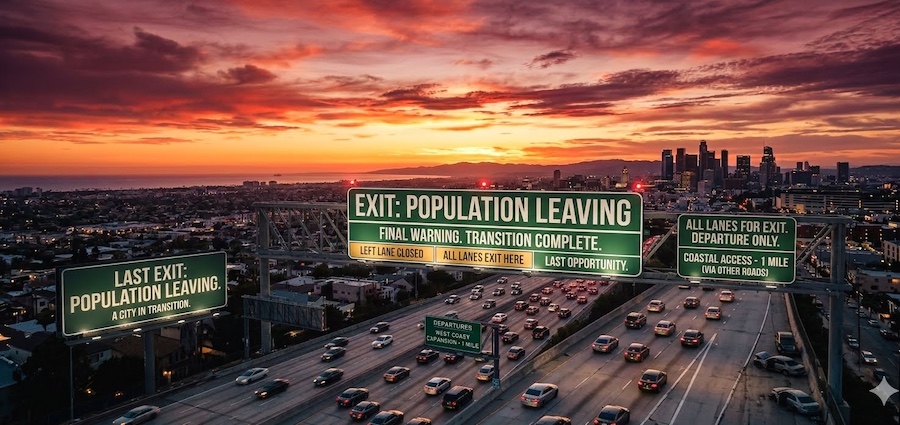
LOS ANGELES COUNTY, CA. (THECOUNT) — Los Angeles County recorded the largest population decline of any county in the United States between July 2024 and July 2025, according to newly released estimates from the U.S. Census Bureau.
Data published March 26 shows approximately 54,000 residents left Los Angeles County during the one-year period, continuing a multi-year trend of population decline in the nation’s most populous county.
|
Advertisement |
Once home to more than 10 million residents in 2020, the county’s population has now dropped to just under 9.7 million, according to reported estimates.
While the number of residents leaving the region is significant, analysts note that a broader shift may be contributing to the decline, including fewer new residents arriving to offset those departures.
Neighboring counties appear to be experiencing population growth during the same period. Riverside County and San Bernardino County combined gained more than 21,000 residents, according to the Census data. The Las Vegas metropolitan area also recorded an increase of more than 20,000 residents.
Despite the decline, Los Angeles County remains the most populous county in the United States, maintaining a population nearly double that of the second-largest county, Cook County, Illinois.
The population decrease is not isolated to Los Angeles County. Across California, similar trends have been observed, with multiple counties experiencing either slowed growth or outright population losses.
In San Diego County, population fell by more than 5,000 residents in 2025, reversing gains recorded the previous year, according to separate reporting based on the same Census Bureau data.
Officials and analysts attribute a portion of the decline to a slowdown in international migration. Census estimates indicate foreign arrivals into San Diego County dropped by approximately 65% year over year, marking one of the steepest decreases in more than a decade.
Nationwide, immigration levels declined in a majority of U.S. counties during the same period. Of the more than 2,000 counties that experienced population growth the previous year, nearly 80% saw that growth slow or reverse in 2025.
California experienced a widespread impact, with all 58 counties reporting declines in foreign immigration. In total, 30 counties in the state recorded overall population losses, an increase from 18 counties the year prior.
Experts note that immigration has historically helped offset declining birth rates and an aging population, particularly in high-cost regions such as coastal California.
Economic implications may emerge as population trends shift. A reduction in working-age residents can affect labor supply, potentially leading to workforce shortages and increased costs for businesses.
Some industries, including construction and service sectors, have reported difficulty finding workers, which has been attributed in part to reduced immigration and continued out-migration.
Domestic migration also remains a contributing factor. Analysts report that more California residents continue to relocate to other states than move into the state, with housing affordability and cost-of-living pressures frequently cited as key reasons.
Despite the population decline, California’s economy remains one of the largest in the world. Some researchers suggest that current population changes reflect economic pressures and policy shifts rather than a broader structural collapse.
Long-term data also shows an ongoing trend. Between 2010 and 2024, nearly 10 million people left California, contributing to a net population loss exceeding 250,000 residents annually in recent years, according to the California Institute for Public Policy.
Among counties experiencing the largest percentage declines were Del Norte County, California, Tuolumne County, California, and Lassen County, California. Outside the state, counties including Taylor County, Florida, and Vernon Parish, Louisiana, also reported notable population losses.
The U.S. Census Bureau continues to monitor population trends nationwide as demographic shifts, migration patterns, and economic conditions evolve.
DEVELOPING::