


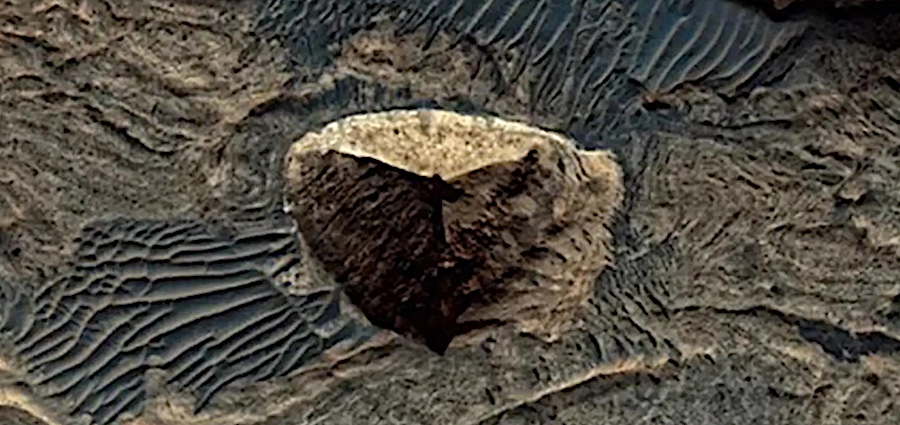
MARS (THECOUNT) — A documentary filmmaker has reignited debate over the possibility of ancient Martian civilization after sharing footage of a three-sided pyramid-shaped formation on the surface of Mars, sparking renewed discussion among researchers, scientists, and space enthusiasts worldwide.
The formation, located in Valles Marineris — the second-largest canyon system in the solar system, stretching approximately 2,500 miles long with depths of up to four miles — was first identified in 2001 by NASA researcher Keith Laney while scanning the Martian terrain using NASA’s Mars Global Surveyor. Laney, who posited at the time that the structure could be artificial, declared that were such a formation found anywhere on Earth, scientists would immediately begin excavating it.
|
Advertisement |
The footage was recently shared to X by documentary filmmaker Brian Dobbs, who noted that the formation appears to be roughly the size of the Great Pyramid of Giza in Egypt. “What geological process creates a three-sided pyramidal structure like this?” Dobbs asked in a YouTube video accompanying the post. “It just is so baffling to me why we can take a look at this and say to ourselves there is nothing to see here, clearly this is an anomaly.”
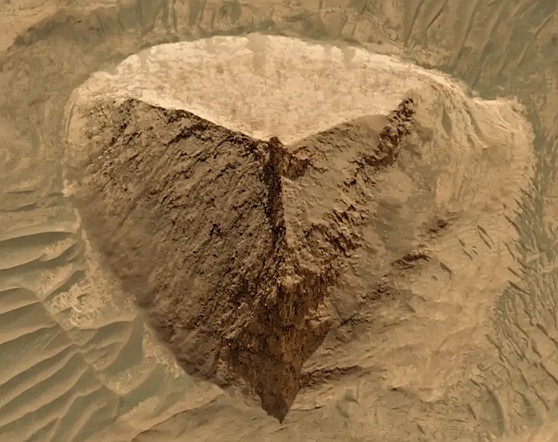
Dobbs stopped short of claiming the structure is definitive proof of Martian life, but pressed for further investigation to rule out artificial origins. The formation has been captured on four separate occasions between 2001 and 2016, maintaining its symmetrical three-sided geometry in each instance.
Dobbs is not alone in his assessment. In a recently published research paper, Mars researcher George Haas argued that the structure exhibits a level of geometry and symmetry that supports a high probability of artificial origins. “You don’t have to be a geologist to know the difference between a rock and a sculpture, something that’s geometric,” Haas told the Daily Mail.
Adding further fuel to the debate, the CIA released documents in 2025 detailing a previously undisclosed reconnaissance mission conducted to gather intelligence on the Martian surface. Those documents reportedly described pyramids scattered across the Martian terrain. Former CIA officer Joe McMoneagle claimed that one of the Martian structures contained what he described as enormous interior chambers and was larger than anything found in Egypt.
Not all scientists are convinced. Harvard researcher Avi Loeb — who has separately drawn attention for his assertion that interstellar comet 3I/ATLAS may be of technological origin — told the New York Post that the pyramid-shaped formation could have a natural explanation. Loeb noted that Mars once had lakes, rivers, and oceans of liquid water, conditions that could theoretically produce unusual geometric rock formations over time. He also cautioned against drawing comparisons to the Egyptian pyramids, noting key structural differences visible in the imagery.
Loeb did, however, express greater interest in a separate cylindrical object discovered on Mars in 2022, which he has suggested could potentially be of non-human technological origin. In a March 8 blog post, Loeb called on NASA’s Curiosity Rover to investigate the object more closely, questioning whether it should simply be assumed to be human-made debris or subjected to further scientific scrutiny.
Valles Marineris is well documented for its dramatic sheer cliffs and layered rock formations, which scientists acknowledge can produce anomalous geometric features under certain erosion conditions. Whether the pyramid-shaped formation falls into that category or represents something more extraordinary remains an open question — one that space researchers on multiple sides of the debate agree warrants further investigation.
NASA has not issued a formal statement regarding the renewed interest in the formation.
DEVELOPING::