


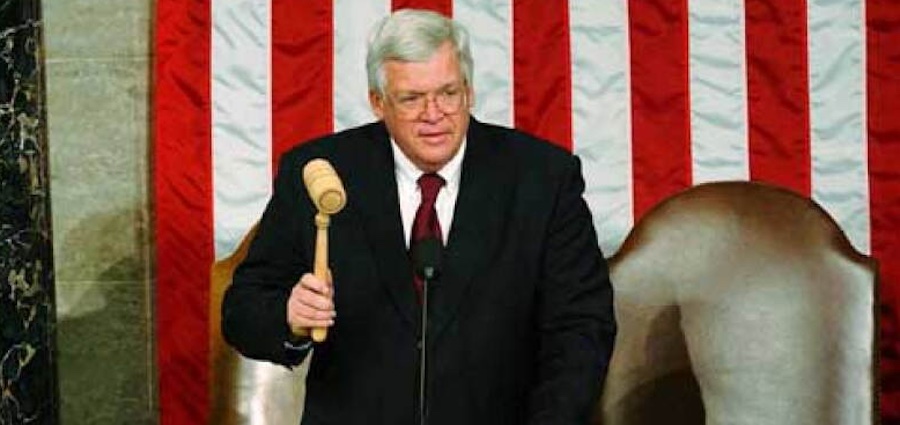
KENDALL COUNTY, IL. (THECOUNT) — Dennis Hastert, the former U.S. House speaker who represented Illinois in Congress for two decades before his political career ended in a federal prison sentence tied to banking violations and hush-money payments, has died at 84.
Hastert died at his home in Kendall County over the weekend from natural causes, according to Kendall County Coroner Jacquie Purcell. The coroner’s office said no further details about his death were available.
Advertisement
Hastert served as speaker of the U.S. House from 1999 to 2007, making him the longest-serving Republican speaker in American history. He represented Illinois’ 14th Congressional District from 1987 until his resignation in 2007 and became one of the most influential Republicans in Washington during the administration of former President George W. Bush.
His political career, however, ultimately became overshadowed by revelations concerning his conduct decades earlier as a high school teacher and wrestling coach.
Born in Aurora, Illinois, in 1942, Hastert grew up in a farming community and attended Wheaton College, where he earned a degree in economics. He later earned a teaching degree from Northern Illinois University.
Hastert spent 16 years working as a teacher and wrestling coach in Illinois. In 1976, he was named Illinois Coach of the Year.

He entered politics through the Illinois General Assembly before winning election to Congress in 1986. Hastert took office in 1987 and steadily rose through the Republican ranks, becoming chief deputy whip in 1995.
When Speaker Newt Gingrich resigned from the leadership post in 1998, Hastert emerged as the eventual successor after Rep. Bob Livingston, who had been expected to become speaker, withdrew amid revelations of extramarital affairs.
Hastert became known as the “accidental speaker” and went on to lead the House for eight years. During his tenure, he worked closely with Bush on major elements of the administration’s legislative agenda and presided over the chamber during the September 11, 2001, terrorist attacks and the subsequent anthrax attacks.
Hastert also became associated with what is informally known as the “Hastert Rule,” a leadership practice calling for House legislation to receive support from a majority of the majority party before being brought to the floor. The practice has remained a subject of debate over congressional partisanship and legislative control.
After Republicans lost control of the House in the 2006 midterm elections, Hastert stepped down from leadership and resigned from Congress in 2007. He later worked as a lobbyist and consultant.
Hastert’s downfall began years later when federal investigators examined large cash withdrawals he had made from his bank accounts. In 2015, prosecutors charged him with illegally structuring withdrawals to evade federal reporting requirements and with making false statements to the FBI.
Hastert pleaded guilty to the banking-related charges. The investigation revealed that the money was being paid to an individual who had been one of his students decades earlier.

During his 2016 sentencing hearing, Hastert acknowledged sexually abusing teenage boys while working as a wrestling coach. Prosecutors said the payments were intended to conceal the abuse. Hastert was not charged with sexual abuse because the applicable statutes of limitations had expired.
U.S. District Judge Thomas M. Durkin sentenced Hastert to 15 months in federal prison, fined him $250,000 and ordered him to participate in a sex-offender treatment program. Hastert ultimately served about 13 months before being released in 2017.
At sentencing, federal prosecutors described the case as having no winners. The revelations permanently altered Hastert’s public legacy, transforming the former House speaker from a longtime Republican power broker into a convicted felon whose career was overshadowed by his admitted abuse.
Hastert was the highest-ranking elected U.S. official to serve a federal prison sentence, and his death closes the life of a politician whose career encompassed both an unprecedented rise within the Republican Party and one of the most dramatic falls from power in modern congressional history.
Hastert was married to Jean Kahl, and the couple had two sons.
Kendall County is located in northeastern Illinois southwest of the Chicago metropolitan area. Hastert’s death occurred at his home in the county, with the coroner’s office providing no additional information about the circumstances beyond the determination that he died of natural causes.
Google Maps: Kendall County, Illinois
DEVELOPING::