


CUPERTINO , CA. (THECOUNT) — For the engineers who spend years refining the tactile feel, optical clarity, and sleek profile of a smartphone display, few sights are quite as painful as a third-party piece of tempered glass slapped across the front.
Tom Marieb, Apple’s vice president of hardware engineering, made no secret of that sentiment in a recent interview with TechRadar, admitting that seeing an iPhone owner apply a screen protector makes his “skin crawl.” That visceral reaction underscores Apple’s immense confidence in its latest display innovation: Ceramic Shield 2.
Advertisement
However, Marieb’s comments have sparked a wider debate across the tech community, laying bare the ongoing clash between Silicon Valley design purism and the practical, risk-avoidant realities of everyday device ownership.
Engineering the New Standard: Ceramic Shield 2:
While Apple first introduced standard Ceramic Shield way back with the iPhone 12, 13, 14, 15, and 16 lineups, Ceramic Shield 2 represents a massive generational leap in mobile display protection. It rolls out across the entire iPhone 17 series, the iPhone 18 line, and the outer screen of the new iPhone Duo foldable.
According to Marieb, Apple set out to resolve a notoriously difficult paradox in materials science: building a surface that resists daily micro-scratches without losing its structural integrity or visual fidelity as the device ages. Traditionally, increasing scratch resistance often compromises other material properties over time. Apple claims that Ceramic Shield 2 delivers three times the scratch resistance of its predecessor, providing a level of baseline toughness that the company believes frees users from feeling the need to cover up the front glass.
The Consumer Divide: Design Purity vs. Practical Utility:
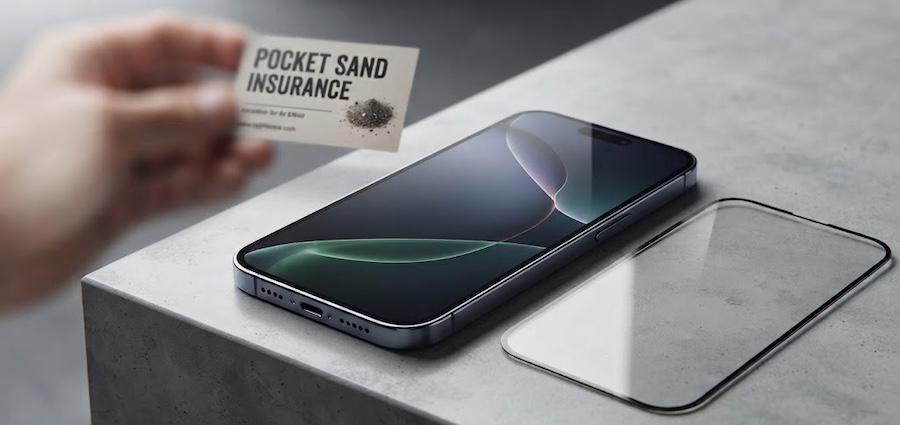
Despite Apple’s technical assurances, the pushback online highlights why screen protectors remain a multi-million-dollar accessory market. The disagreement is rarely about whether Ceramic Shield 2 is tough—it is. Rather, it comes down to economic risk management, individual utility, and the silent, ubiquitous threat of pocket sand.
While Ceramic Shield 2 easily shrugs off blunt objects like keys or coins in a pocket, it remains vulnerable to the true enemy of modern smartphone displays: microscopic grit and quartz particles. When you slide your phone into a pocket or bag that has accumulated fine dust, beach sand, or soil, those microscopic mineral particles act as an abrasive paste. Rubbing against the glass under normal daily friction, pocket grit is hard enough to leave fine hairline micro-scratches that accumulate over months of use.
Ultimately, choosing whether to keep a screen protector comes down to a simple trade-off between pure device feel and peace of mind:
Skip the protector if: You prefer enjoying Apple’s intended design, smooth glass edges, and pure optical clarity, and you don’t mind the slight risk of minor micro-scratches from pocket grit over time.
Keep the protector if: You are rougher on your phone, regularly toss it into bags with keys or abrasive debris, or want to protect its resale value by keeping the front glass completely pristine.
Beyond scratch prevention, millions of users also rely on screen protectors for functions that no amount of raw glass durability can replace—such as privacy filtering for commuting or specialized matte anti-glare coatings.
Entering the Fold: The iPhone Duo and Hinge Mechanics
That same obsession with long-term durability is central to Apple’s expansion into foldable form factors with the iPhone Duo. Designing a reliable foldable requires solving mechanical and display challenges that traditional slab-style phones never encounter.
Marieb highlighted the extensive engineering behind the Duo’s hinge system, noting that the team spent countless hours ensuring it feels secure and deliberate in every position—open, closed, and partially folded. Apple’s internal benchmark was tactile: the mechanism had to close with the solid, reassuring weight of a high-end car door rather than feeling loose or “floppy.”
“A lot of blood, sweat, and tears went into that,” Marieb noted. To mitigate the crease visibility common to foldable inner displays, Apple equipped the Duo’s inner screen with a specialized matte finish designed to diffuse light and minimize disruption. Rather than asking for blind trust, Marieb invited public scrutiny over how well those materials hold up in the wild: “Hold us accountable to that,” he challenged.
Analysis: The Philosophy of Durability:
Marieb’s candid remarks point to a fascinating philosophical divide in modern consumer electronics. From an OEM (Original Equipment Manufacturer) perspective, a smartphone is an integrated work of industrial art. Every contour, transition, and optical layer is meticulously balanced. When a user introduces an aftermarket accessory, they alter the weight, edge-swipe feel, and light transmission that the designer intended.
Yet, from the consumer’s vantage point, a phone is also a high-stakes investment and an indispensable daily tool. Apple’s push toward unbreakable resilience—typified by Ceramic Shield 2 and rigorous hinge engineering—moves the industry closer to a world where protective accessories become obsolete. But until repair costs drop dramatically or built-in insurance models shift, users will likely continue prioritizing financial peace of mind and defense against invisible pocket grit over executive aesthetic preferences.
DEVELOPING::