


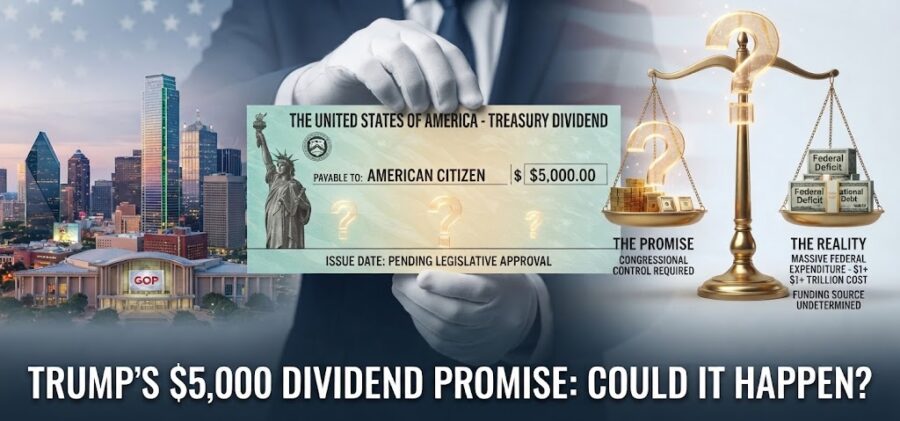
DALLAS, TX. (THECOUNT) — President Donald Trump has made a striking promise to American voters: If Republicans win control of both the U.S. House and Senate in the November midterm elections, he says every adult U.S. citizen would receive a $5,000 “dividend.”
But there is a much bigger question behind Trump’s promise: Could a $5,000 payment to every adult U.S. citizen actually happen?
Advertisement
Trump made the announcement Wednesday during the Republican midterm convention in Dallas, saying the proposed payment would be a “dividend” based on what he described as the country’s economic strength and success. He called the proposal the “Trump Dividend.”
Trump said the condition is that Republicans win both the House and Senate in November. He also said the money would have to be spent within the United States.
But Trump did not provide details about how the payments would be administered or exactly how the program would be funded. Reuters reported that no additional details were immediately available following the announcement.
And the numbers involved are enormous.
The Associated Press reported that the proposal would likely cost more than $1 trillion. The Census Bureau does not maintain a simple count of adult U.S. citizens, but nearly 270 million adults live in the United States. Even limiting the payments to adult citizens would therefore produce a massive federal expenditure.
That raises the central question of the proposal: Where would the money come from?
Trump did not provide a detailed funding formula in his announcement. Without knowing the eventual eligibility requirements, payment structure and funding source, the ultimate cost cannot yet be determined precisely.
There is also a congressional question. Winning control of the House and Senate would not, by itself, create a $5,000 payment program. A program involving a federal expenditure of this size would have to move through the legislative process and receive the necessary authorization.
That means Trump’s announcement is currently a promise contingent on an election outcome, rather than an approved federal benefit.
The distinction is important for Americans wondering whether they should expect a $5,000 check. There is currently no federal program guaranteeing such a payment, and no payment date has been established.
Trump compared the proposed dividend to the way a successful company might distribute money to its shareholders. He said the proposed payments would reward Americans for the country’s economic success while requiring the money to be spent domestically.
The proposal also comes during an election year in which control of both chambers of Congress will be decided. All 435 House seats are up for election, along with the Senate races scheduled for the 2026 midterms.
If Republicans win both chambers, the $5,000 proposal would still face the practical questions that have not yet been answered: Who would qualify? How would citizenship and age be verified? Would there be income limits? How would the Treasury distribute the money? And what specific source of federal revenue would pay for it?
Those questions could substantially affect both the cost and the structure of any eventual program.
For now, the answer to whether Americans will actually receive $5,000 is simple: not yet.
Trump has made the promise, but the proposal has not become a federal payment program. Whether it could become one would depend on the outcome of the congressional elections, legislation passed by Congress, funding and the eventual rules governing the payments.
Dallas, Texas, is the state’s third-largest city and the urban center of the Dallas-Fort Worth-Arlington metropolitan area, one of the largest metropolitan regions in the United States. The city hosted the Republican midterm convention where Trump announced the proposed dividend.
View Dallas, Texas on Google Maps
DEVELOPING::