


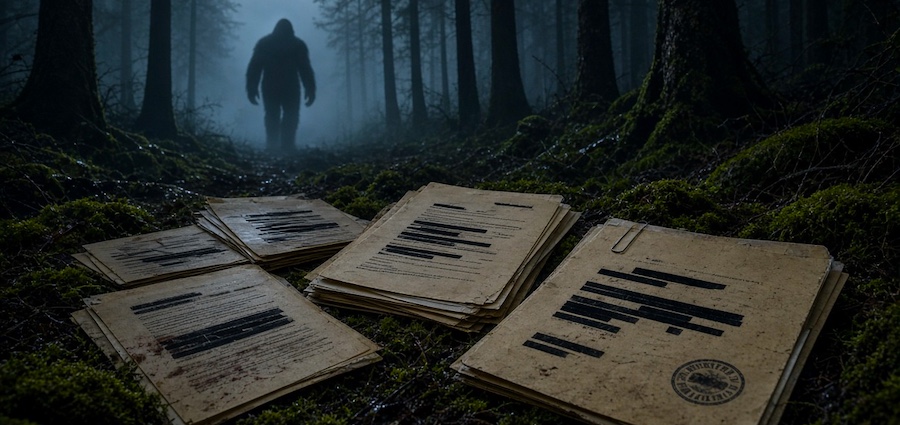
WALLA WALLA, WA. (THECOUNT) — Newly published government records are shedding light on a decades-old investigation into alleged Bigfoot tracks in the Pacific Northwest, including a 1982 examination of enormous footprints that left one federal biologist puzzled and a U.S. Border Patrol tracking expert convinced someone had staged an elaborate hoax.
The U.S. Forest Service posted three historical documents under the title “Bigfoot/Sasquatch Records” in its online Freedom of Information Act Reading Room on Oct. 15, 2026. The files detail reported encounters in Montana and an investigation of alleged Sasquatch tracks in the Mill Creek Watershed of the Umatilla National Forest.
Advertisement
The records do not establish that Bigfoot exists. Instead, they offer a rare look at how federal personnel examined reported evidence, documented their observations and reached conflicting conclusions about what made the footprints.

Rodney L. Johnson, a Forest Service wildlife biologist, authored the central report after joining an investigation on June 17, 1982. The team examined alleged tracks at two locations in the watershed and photographed the impressions. Investigators also made plaster casts of several prints.
At Site A, the team documented six identifiable footprints extending approximately 25 feet along a muddy trail. One measured about 15 inches long and 7 inches wide. At Site B, investigators found approximately 18 prints stretching about 40 feet through soft mud toward dense vegetation. The report described signs of disturbance in the brush beyond the tracks.
A third location, Site C, reportedly contained 12 tracks in a dry, open area. Johnson did not visit that site, relying instead on information provided by the watershed rider.

Johnson ultimately concluded that the Site A and Site B impressions were made by “something other than a 300-pound-plus, two-footed being.” He listed several reasons, including the unusually consistent four-foot stride across different slopes, the fact that investigators’ boots sank deeper into the mud than the alleged footprints, and the absence of tracks leading into or away from the impressions.
He also questioned why the toe markings appeared so clearly defined and noted that forest litter seemed to have been brushed aside before some of the impressions were made. Other details suggested the foot may have been rocked from side to side while creating the prints.
But Johnson acknowledged that the impressions were not easy to dismiss. He wrote that if they were fabricated, someone had gone to considerable effort. He described the markings as unusually natural-looking and suggested a cast of an actual foot might have been used to create the impressions.

Joel Hardin, a U.S. Border Patrol tracking expert, later submitted a separate memorandum dated July 28, 1982. His assessment was more definitive. Hardin called the tracks “a very clever attempt to perpetrate a hoax” and believed they had been made with a foot-shaped device coated in soft plaster or rubber.
Hardin cited the identical stride across different terrain, the lack of natural movement in the heel and ball of the foot, and the absence of tracks leading to or away from the impressions. He suggested the person responsible may have intended to make the Forest Service appear to authenticate Bigfoot evidence. The memorandum did not identify a suspect.
THE OTHER BIGFOOT FILES
One of the remaining records contains an account written by Leo T. Kinney describing a 1949 hunting trip near Petty Creek, Montana. Kinney said he and other hunters returned to retrieve an elk carcass but found only the entrails. Large tracks led away through the snow, and the group followed them for approximately half a mile.
Kinney also recounted a separate incident in 1950 involving W.W. Schmitz, who reportedly discovered similar tracks, detected a strong odor and heard grunting. Neither account described anyone actually seeing the creature.

The third document is a newspaper clipping from the Jan. 15, 2003, edition of the Clark Fork Valley Press. It describes an eight-year-old boy, Austin Peterson, finding unusual footprints near River Road West in Montana. The newspaper reported that some impressions measured approximately 16½ inches long and 8½ inches wide. A neighbor reportedly followed the trail roughly 100 yards into the woods before losing it as the snow became thinner. Rain later washed away much of the evidence.
The 1982 investigation has also drawn renewed attention because not everyone who examined the alleged tracks agreed with the federal investigators. The late Grover Krantz, an anthropology professor at Washington State University who studied Bigfoot reports, argued that details in casts of the footprints were difficult to reproduce artificially. The debate over those impressions has continued among Bigfoot researchers and skeptics.
The Forest Service’s release is a collection of historical records, not an official confirmation of Sasquatch. The documents preserve reported encounters, photographs, measurements and competing assessments, but they provide no conclusive physical evidence establishing the existence of the creature.

The 1982 investigation took place in the Mill Creek Watershed of the Umatilla National Forest, in the Walla Walla region of southeastern Washington. The exact track locations have not been established as public map destinations, so a precise scene pin cannot be reliably provided.
DEVELOPING::