


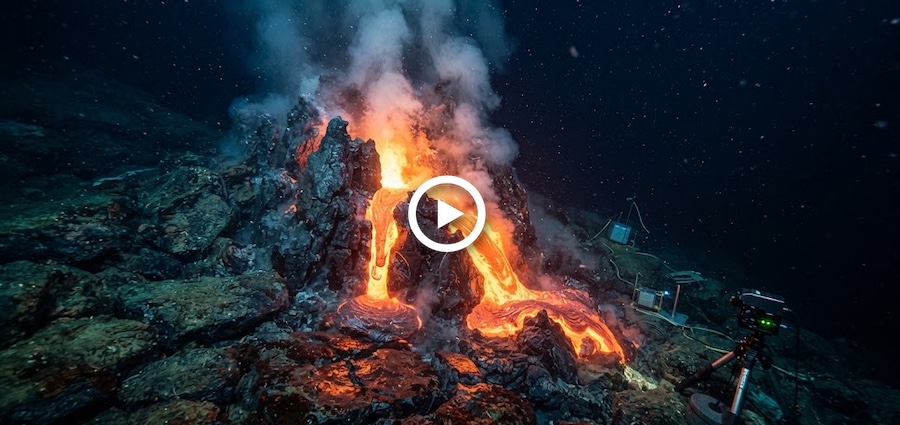
OFF THE OREGON COAST, OR. (THECOUNT) — Scientists are continuing to monitor Axial Seamount, an active underwater volcano located approximately 300 miles off the Oregon Coast, as researchers study whether changes beneath the Pacific Ocean can help forecast its next eruption.
Axial Seamount sits roughly 4,600 feet beneath the ocean surface along the Juan de Fuca Ridge, an underwater tectonic boundary where the Pacific and Juan de Fuca plates are pulling apart and new oceanic crust is formed.
Advertisement
The volcano has erupted three times in recent decades, in 1998, 2011 and 2015. Those repeated eruptions have made Axial an important natural laboratory for scientists studying volcanic activity and the possibility of forecasting eruptions before they occur.
Unlike most volcanoes, Axial Seamount is monitored through instruments installed on the seafloor and connected to shore through the Ocean Observatories Initiative’s Regional Cabled Array. The system allows researchers to examine seismic activity, pressure, seafloor movement and other measurements in near real time.
One of the most important measurements is the inflation of the volcano’s caldera. As magma accumulates beneath Axial, the seafloor rises. Scientists compare the rate of that uplift with patterns recorded before earlier eruptions.
Researchers have previously observed that Axial’s inflation and earthquake activity increased before its 1998, 2011 and 2015 eruptions. That pattern led scientists to believe the volcano might provide an unusual opportunity to test whether an eruption could be forecast using real-time data.
However, the volcano’s activity has not followed a simple schedule.
In a July 2026 update, Oregon State University volcanologist Bill Chadwick reported that the rate of seafloor uplift had slowed. The average six-month inflation rate had declined to approximately 6.5 centimeters per year, while the average three-month rate was about 4.5 centimeters per year.
Earlier measurements had shown faster inflation, including rates near 9 centimeters per year over a longer period. Earthquake activity beneath the volcano also remained relatively low, generally below 100 small earthquakes per day, although occasional bursts reached several hundred earthquakes.
Based on those observations, researchers said the next eruption did not appear imminent at the time of the update.
That assessment does not mean Axial Seamount is inactive. The volcano remains fully reinflated, and scientists continue watching for changes in the rate of uplift and seismic activity that could indicate magma is moving closer to the surface.
The changing inflation rate also highlights the difficulty of forecasting volcanic eruptions. Researchers had previously expected Axial to erupt during an earlier time window, but the forecast changed as the volcano’s behavior changed.
Scientists are using the ongoing monitoring effort to test a broader question: Can volcanic eruptions be forecast before they happen, or can researchers only recognize the warning signs after an eruption is already underway?
Axial Seamount’s location makes it particularly valuable for that research. The volcano is deep underwater and far offshore, allowing scientists to study an active volcanic system without the immediate threat to populated communities associated with many land-based volcanoes.
The U.S. Geological Survey has said Axial’s eruptions are generally effusive, meaning they produce lava flows rather than the explosive eruptions associated with volcanoes such as Mount St. Helens. Because of its depth and distance from shore, Axial is not considered a threat to people living along the Oregon, Washington or California coasts.
An eruption would nevertheless be a major scientific event. Instruments connected to the seafloor observatory could allow researchers to observe changes in pressure, earthquakes and seafloor deformation as the eruption develops.
Axial Seamount is not visible from the Oregon Coast. There is no above-water volcanic mountain, smoke plume or lava fountain for residents to see. Instead, scientists rely on data from the ocean floor to track the volcano’s activity.
Researchers continue to update their observations as new measurements become available. The timing of the next eruption remains uncertain, and the latest slowdown in inflation does not establish that an eruption is about to occur.
Axial Seamount is located in the Pacific Ocean along the Juan de Fuca Ridge, approximately 300 miles west of the Oregon Coast and near the broader Pacific Northwest region. The volcano is far beyond the shoreline and is accessible primarily through scientific monitoring systems and research expeditions.
DEVELOPING::