


SAN MATEO COUNTY, CA. (THECOUNT) — What initially appeared to be a strangely shaped rock in a Northern California creek has been identified as an exceptionally well-preserved tooth from an adult Pacific mastodon, an extinct relative of modern elephants that roamed the region thousands of years ago.
The remarkable fossil was discovered by Brigid Lynch, a geomorphologist with Balance Hydrologics, while she was conducting field surveys in a creek bed at a Midpeninsula Regional Open Space District preserve in San Mateo County, according to officials.
Advertisement
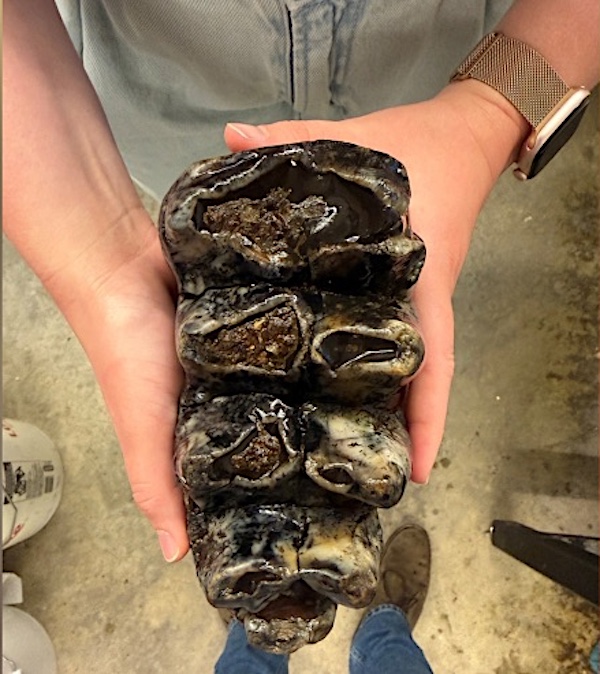
Lynch made the discovery while working on surveys connected to a Midpen habitat enhancement project supporting the threatened California red-legged frog. What she initially found appeared to be an oddly shaped rock, but further examination revealed an intact mastodon molar.
“As a geologist, I’ve gone out and seen stuff in the field, but definitely nothing as exciting as this,” Lynch said.

Paleontologist Wayne Thompson, owner of Pacific Paleontology, examined the fossil and described it as being in extraordinary condition.
“The tooth itself is in immaculate condition,” Thompson said, calling it the most complete mastodon molar from the area and the most spectacular mastodon molar he had seen.
Researchers believe the tooth could be approximately 10,000 years old, although its precise age has not yet been established. The fossil has been donated to Stanford University’s Doerr School of Sustainability, where researchers plan to use carbon dating to determine its age more precisely.
The Stanford team also plans to create a 3D scan of the fossil and produce a replica for Midpen to use in public outreach and education.
The tooth belonged to a Pacific mastodon, scientifically known as Mammut pacificus. The species is distinct from the better-known American mastodon, Mammut americanum, with differences including narrower teeth, thicker leg bones and variations in its tusks.
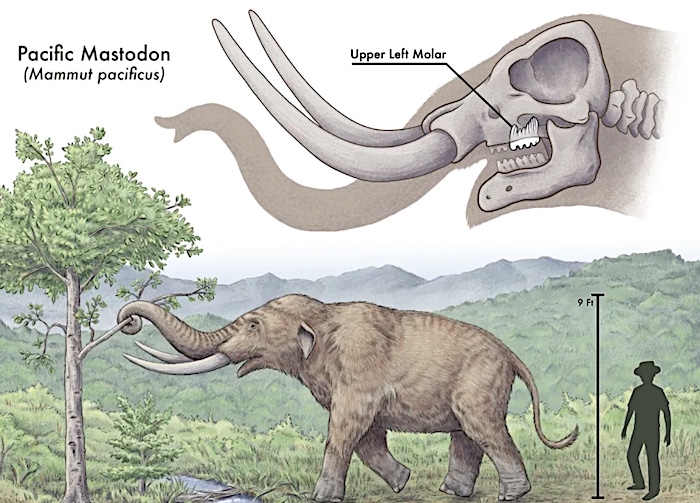
Pacific mastodons are believed to have ranged across what is now California, Oregon, the northern Rocky Mountain region of the western United States and parts of Mexico.
The massive herbivores lived during the Pleistocene Epoch, which began approximately 2.5 million years ago. Researchers believe Pacific mastodons disappeared around 11,700 years ago.
Unlike mammoths, which primarily fed on grasses, mastodons were browsers. They used their trunks to strip leaves, soft shoots and fruit from trees and other woody vegetation.
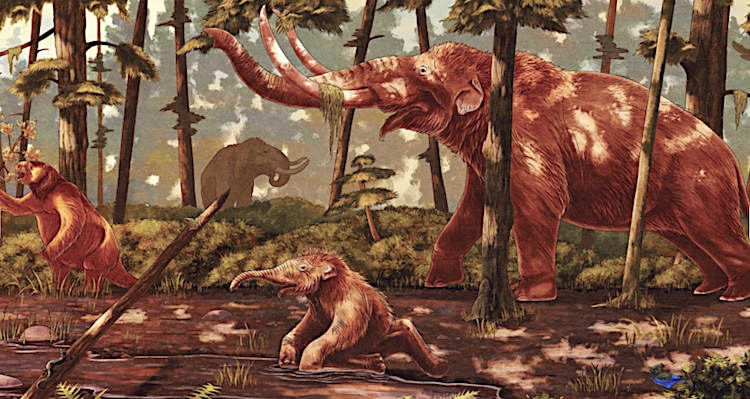
The discovery also provides a glimpse into the ancient ecosystem of the San Francisco Bay Area. Officials said mastodons shared the landscape with other now-extinct animals, including saber-toothed cats, dire wolves, Jefferson’s ground sloths, western camels and Columbian mammoths.
Some animals that remain in the region today, including mountain lions, bobcats, coyotes, badgers, tule elk and gray foxes, have ancient counterparts in the fossil record of the area.
Christine Garcia, curator and manager of Stanford’s Geoscience Specimen Collection, said fossils provide an opportunity to study biodiversity from Earth’s past and better understand the ecosystems in which extinct species lived.
The discovery is particularly notable because the fossil was found during a modern habitat restoration project, offering researchers an unexpected connection between the region’s ancient wildlife and ongoing efforts to protect its present-day ecosystems.
San Mateo County is located on the San Francisco Peninsula in Northern California, directly south of San Francisco and along the Pacific coast. The county encompasses portions of the Peninsula’s coastal forests, open-space preserves and watersheds where the mastodon fossil was discovered.
DEVELOPING::