


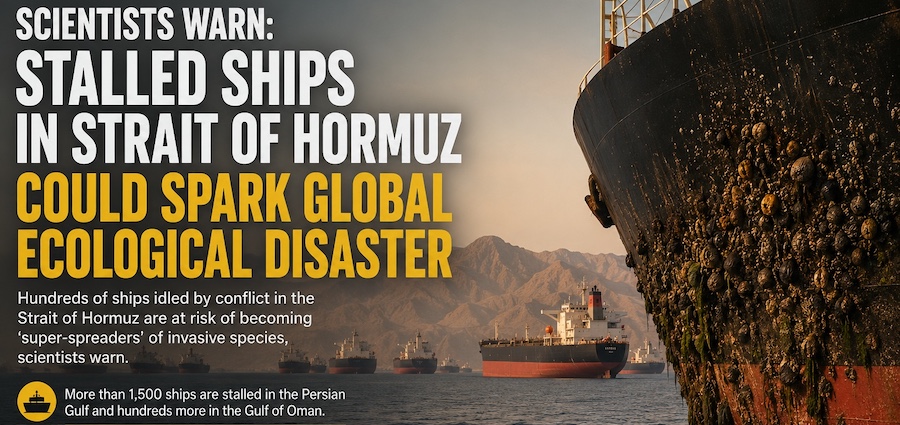
STRAIT OF HORMUZ (THECOUNT) — A growing number of stalled commercial vessels in the Strait of Hormuz could create conditions for a major spread of invasive marine species, according to scientists who warn that prolonged ship inactivity may allow organisms to build up on hulls before being transported to new ecosystems around the world.
The Strait of Hormuz, located between the Persian Gulf and the Gulf of Oman, is one of the world’s most important maritime routes, carrying roughly 20% of global oil supplies, according to the U.S. Energy Information Administration. Ongoing disruptions in the region have reduced tanker movement and left large numbers of vessels idle in surrounding waters.
Advertisement
A study published Wednesday in the journal Biological Invasions examined the potential environmental consequences of prolonged ship stoppages, focusing on a process known as biofouling. The buildup occurs when microorganisms, algae, plants and marine animals attach themselves to the exterior surfaces of vessels.
Mario Tamburri, a marine ecologist with the University of Maryland Center for Environmental Science and the lead author of the study, said stationary ships can become ideal platforms for marine organisms to grow and later travel across oceans when vessels resume operations.
Tamburri said commercial ships are typically protected with anti-fouling coatings designed to prevent organisms from attaching to their hulls. However, those protections can become less effective when vessels remain idle for extended periods, increasing the likelihood of significant biological buildup.
The concern is that organisms native to the Strait of Hormuz region could survive long-distance voyages and establish themselves in foreign environments. Scientists said species that can tolerate the area’s warm, highly saline waters may have a greater chance of surviving transport to other regions.
One example cited by Tamburri is the zebra mussel, an invasive species originally from the Caspian and Black Sea regions that spread throughout the Great Lakes during the 1980s. According to the National Park Service, zebra mussels have since expanded into additional waterways, including parts of the Mississippi River system and areas on the West Coast through human transportation.
Once invasive marine species become established, removal efforts can be extremely difficult and expensive. Scientists said prevention and early detection remain among the most effective methods for limiting ecological damage.
The research noted that more than 1,500 ships were idle in the Persian Gulf, with hundreds of additional vessels anchored in the Gulf of Oman at the time of the study. Researchers said the combination of a large number of ships, extended inactivity, warm waters and global shipping connections creates an elevated biosecurity concern.
Tamburri compared the situation to a worst-case scenario because marine organisms attached to vessel hulls can reproduce while ships remain stationary, creating larger colonies before transport occurs.
Environmental scientists said cleaning ship hulls before departure is a key step in reducing the spread of invasive species. Some ports already provide in-water cleaning services, although researchers recommend using equipment that captures removed organisms rather than allowing them to return to surrounding waters.
Future regulations could place additional requirements on vessels with heavy biofouling. New Zealand currently requires ships entering its waters to meet clean-hull standards, and the International Maritime Organization has been working to strengthen global biofouling management practices.
DEVELOPING::