


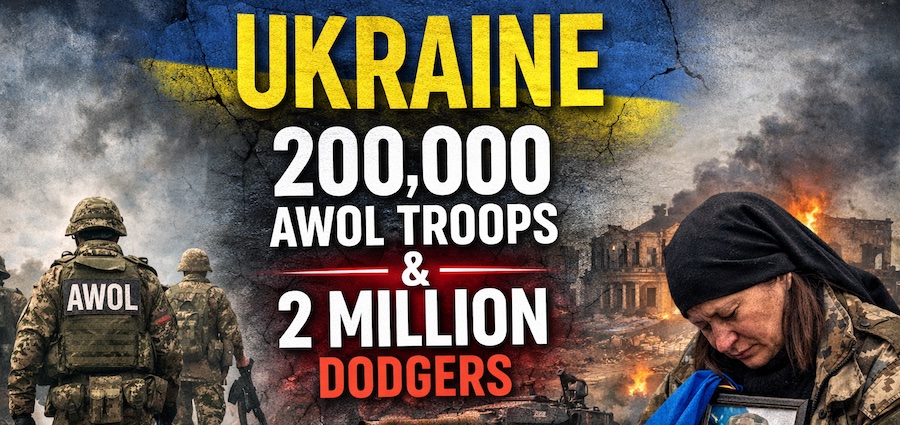
KYIV, UKRAINE (THECOUNT) — Ukraine’s new Defense Minister Mykhailo Fedorov revealed that approximately 200,000 Ukrainian soldiers are absent without official leave (AWOL), leaving their posts without permission amid the ongoing conflict with Russia. Fedorov also stated that around 2 million Ukrainians are currently “wanted” for avoiding military service, highlighting the immense pressure facing Kyiv’s armed forces.
Fedorov made the disclosure while speaking in the Ukrainian Parliament ahead of the vote that confirmed him as the country’s youngest-ever defense minister. Turning 35 next week, Fedorov replaces Denys Shmyhal, who became Ukraine’s First Deputy Prime Minister and Minister of Energy.
|
Advertisement |
Under Ukrainian law, all men aged 18 to 60 must register with the military and carry their documents, though only those between 25 and 60 are subject to mobilization. Martial law prevents men aged 23 to 60 eligible for service from leaving the country, yet tens of thousands have reportedly fled illegally to avoid conscription.
President Volodymyr Zelensky met with Fedorov on Wednesday and noted that “broader changes” were necessary to improve the country’s mobilization process. “More robots means fewer losses, more technology means fewer deaths. The lives of Ukrainian heroes are of the highest value,” Fedorov said, emphasizing the critical role of technology in offsetting manpower shortages.
Fedorov, who previously served as Deputy Prime Minister and Minister of Digital Transformation, has overseen Ukraine’s advanced drone warfare program. He stated that the country now has roughly 500 companies producing drones, 200 firms making electronic jamming equipment, and more than 20 private missile producers. Strengthening the technological component of the military will be a central focus of his tenure as defense minister.
The Ukrainian military has been under extraordinary strain, facing a much larger and better-equipped Russian force along extended frontlines. Conditions have been harsh, with Ukrainian troops often outnumbered and outgunned while defending strategic positions. Rumors of low morale and high desertion rates have circulated for months, but Fedorov’s statements mark the first official disclosure of the scale of the problem.
Meanwhile, Russian forces have suffered catastrophic losses, according to independent media investigations. Mediazona, in collaboration with the BBC Russian Service, confirmed the identities of 168,142 Russian military personnel killed in Ukraine. Since their last update in mid-January, 4,536 additional Russian soldier deaths were added to the count. The verified figures include over 54,600 volunteers, 20,200 recruited prisoners, 17,400 mobilized soldiers, and 6,353 officers.
The actual number of Russian casualties is widely considered higher, as verification depends on publicly available sources such as obituaries, social media posts by relatives, regional media, and local authority statements. Russian authorities rarely publish official casualty figures and have reportedly increased efforts to remove court records and other public data concerning soldiers’ fates.
The losses come amid a report from the Center for Strategic and International Studies (CSIS), released Jan. 27, which estimates that Russian forces have sustained nearly 1.2 million casualties—including killed, wounded, and missing—since the start of the invasion in February 2022. The report estimates roughly 325,000 Russian soldiers have been killed, consistent with Ukraine’s General Staff figures and Western intelligence assessments.
Despite these heavy losses, Russian forces have been able to make minor advances along Ukraine’s frontlines, replenishing personnel through fresh contract soldiers. Ukraine’s open-source mapping project DeepState reports that Russian forces occupied 4,336 square kilometers (1,674 square miles) of Ukrainian territory in 2025, accounting for less than 1% of the country.
The disclosure of widespread AWOL Ukrainian soldiers and Russia’s unprecedented casualties underscores the immense human cost of the conflict. Officials in Kyiv are attempting to address manpower shortages while simultaneously leveraging technological innovation to maintain battlefield effectiveness. Meanwhile, analysts continue to monitor Russian operational capabilities and troop movements as the war enters its fourth year.
DEVELOPING::